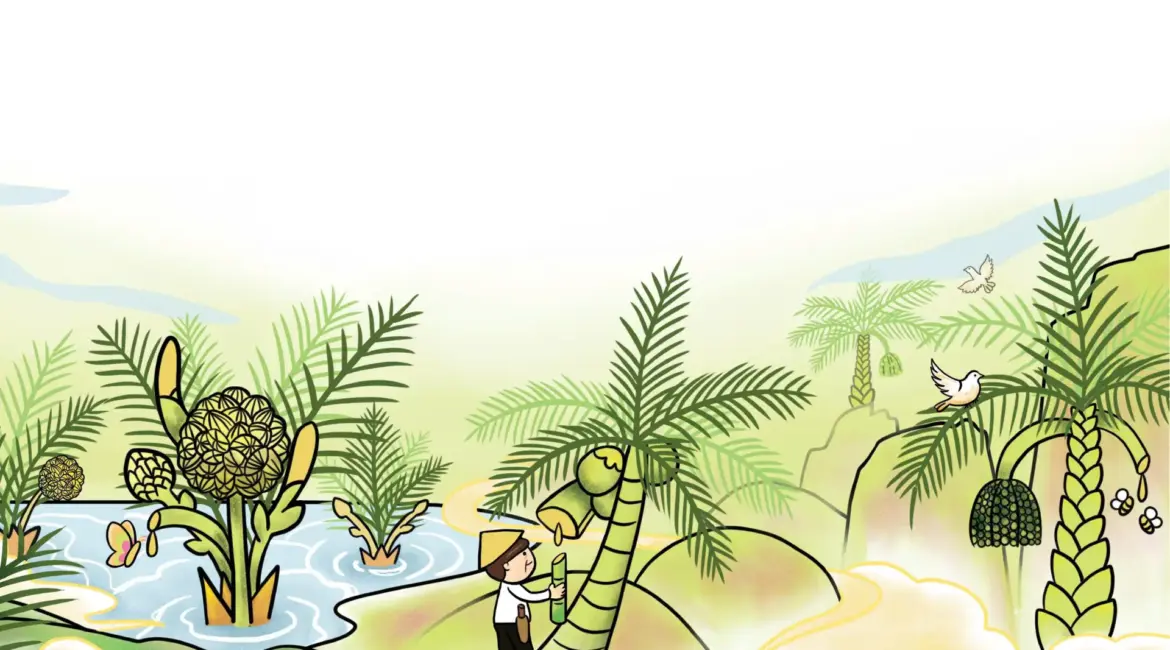
When people think of palm trees, they usually think of coconuts, tropical beaches and long green leaves moving in the wind.
But some palm trees can also give us a naturally sweet liquid from their flower stalks. This liquid is called palm blossom nectar.
Palm nectar has been collected by farming communities in Vietnam for many generations. In Central Vietnam, it comes from very different landscapes: the river wetlands around Hoi An, the countryside of Quang Nam and the mountain forests of the Truong Son Range.
At Hoa Arika Hoi An, palm blossom nectar is at the centre of every drink we make.
Instead of refined sugar, we use fresh nectar from three palm species:
- Nipa palm
- Coconut palm
- Arenga palm
Some drinks use one type of nectar, while others combine two or even all three.
Each nectar comes from a different place and has its own flavour, character and harvesting story.
What Is Palm Blossom Nectar?
Palm blossom nectar is the naturally sweet sap collected from the flower stalk of certain palm trees.
It does not come from the fruit.
For example, coconut blossom nectar is not the same as coconut water. Coconut water is found inside the coconut fruit, while blossom nectar is collected from the flower stalk before it develops into a mature bunch of coconuts.
Before farmers can collect the nectar, they must prepare the flower stalk over many days or even several weeks. When the stalk is ready, a small part at the end is cut, allowing the nectar to slowly drip into a clean container.
Fresh palm blossom nectar has a light and gentle sweetness. It is usually less sharp than refined white sugar and also brings its own natural aroma.
The flavour may change depending on the palm species, growing area, weather and season.
Fresh nectar is also very delicate. In hot weather, it can begin to ferment naturally within only a few hours. For this reason, careful collection, clean handling and quick cooling are very important.
The Three Palm Nectars Behind Hoa Arika Hoi An
Hoa Arika Hoi An uses fresh nectar from three palm species.
These palms grow in three different natural areas: river wetlands, countryside gardens and mountain forests.
Together, they bring the landscapes and farming traditions of Central Vietnam into our drinks.
1. Nipa Palm Nectar: From the Waterways of Quang Nam and Quang Ngai
The nipa palm, scientifically known as Nypa fruticans, grows in wetlands, river mouths and areas where fresh water meets the sea.
In Vietnam, it is commonly called the water coconut palm.
Unlike a normal coconut palm, most of its trunk stays below the mud. Its long leaves grow directly from the ground and water, creating thick green forests along rivers and canals.
In Central Vietnam, nipa palms are found in several areas, especially around Hoi An, Nui Thanh and Quang Ngai.
The nipa palm is closely connected with Hoi An through the well-known water coconut forests of Cam Thanh (nipa palm village). These palms have been part of the local landscape and daily life for many generations.
Hoa Arika works with farmers in Quang Nam and Quang Ngai to collect fresh nipa palm nectar.
However, the amount of nectar depends greatly on the season and weather. At certain times, the local harvest is not enough for our production.
When this happens, we also work directly with farmers in the Mekong Delta, where the largest areas of nipa palm in Vietnam can be found.
Nipa nectar has a clean and refreshing sweetness. It works especially well with tea, coffee, fruit and milk-based drinks.
2. Coconut Blossom Nectar: From the Midland Gardens of Quang Nam
Our coconut blossom nectar comes from the midland areas of Quang Nam, including Dai Loc, Dien Ban and Que Son.
These farming areas are around 40 kilometres west of Hoi An, where the coastal plains slowly rise towards the hills.
The coconut palms here are grown and tapped by local farmers. The nectar is collected directly from the flower stalk, not from the coconut fruit.
Fresh coconut blossom nectar has a smooth and familiar sweetness, with light floral and caramel-like notes.
It blends easily with coffee, tea, fruit, matcha and sparkling drinks. It gives sweetness without covering the original flavour of the other ingredients.
3. Arenga Palm Nectar: From the Truong on Mountains
The arenga palm, scientifically known as Arenga pinnata, grows in the mountainous districts of Nam Giang, Tay Giang and Dong Giang.
These areas are part of the Truong Son mountain range, approximately 80 to 120 kilometres from Hoi An.
They are also the traditional homeland of many Co Tu communities.
The Co Tu people have collected nectar from arenga palms for hundreds of years. They know how to choose the right flower stalk, how to prepare it and when to make the first cut.
This knowledge is difficult to learn from a book or a short training course. It comes from years of observing the trees and working with them in different seasons.
Hoa Arika works directly with Co Tu farmers who continue to practise and preserve this traditional harvesting method.
Arenga nectar usually has a deeper and more complex flavour than nipa or coconut nectar. Depending on the tree and season, it may have floral, earthy or lightly caramel-like notes.
Why Is Palm Nectar So Difficult to Harvest?
Collecting palm nectar is not as simple as cutting a flower stalk and waiting for the liquid to flow.
Before the first cut, farmers must carefully prepare the flower stalk every day.
The stalk is massaged, bent or gently tapped twice a day. This process helps prepare the internal structure of the stalk so that it may release nectar later.
The preparation time is different for each palm species:
- Nipa palm: around 15 days
- Coconut palm: around 20 days
- Arenga palm: around 30 to 45 days
This work must be done regularly and with the right amount of force.
If the farmer taps too strongly, chooses the wrong stalk or makes the cut too early, the nectar may not flow.
Even after several weeks of preparation, there is no guarantee that the harvest will be successful.
Not every flower bunch can produce nectar. Two flower stalks on the same tree may give very different results. One may produce a good amount, while another may give very little or nothing at all.
An experienced farmer looks at the age, shape, firmness and condition of the stalk. The farmer may also listen to the sound it makes when tapped and watch how it changes during the preparation period.
The basic steps may look simple, but successful harvesting requires patience, practical knowledge and many years of experience.
This is also why not everyone can produce good palm nectar, even when following the same instructions.
What Makes Palm Blossom Nectar Special
Palm blossom nectar is still a natural source of sugar, so it should be enjoyed in a reasonable amount.
However, it is different from refined white sugar in several important ways.
A Gentle and Natural Sweetness
Refined sugar mainly adds sweetness.
Fresh palm nectar adds sweetness together with its own aroma and flavour.
Depending on the palm species, it may taste floral, fruity, earthy, lightly nutty or caramel-like.
Its sweetness is usually smooth and not too sharp. This allows the natural taste of coffee, tea, fruit, herbs and spices to remain clear in the drink.
Naturally Occurring Minerals and Electrolytes
Fresh palm nectar can naturally contain minerals such as potassium, sodium, calcium and magnesium.
Some of these minerals, including potassium and sodium, also act as electrolytes in the body.
Palm nectar may also contain small amounts of vitamins, amino acids and other natural plant compounds.
However, the exact composition is not always the same. It depends on the palm species, soil, season, weather and the way the nectar is collected, stored and processed.
A Comparatively Low Glycaemic Index
Some palm-based sweeteners are known to have a lower glycaemic index than refined cane sugar.
However, there is no single GI value that applies to every palm nectar.
The actual value may change depending on the palm species, growing conditions, concentration, processing method and the final product.
A lower glycaemic index also does not mean that palm nectar is sugar-free or can be consumed without limits.
At Hoa Arika Hoi An, we do not present palm nectar as a medicine or a health treatment. We use it because it is natural, flavourful and closely connected to the land and farming communities of Vietnam.
Every Drink at Hoa Arika Is Sweetened with Palm Nectar
Every drink on the Hoa Arika Hoi An menu is sweetened with at least one of our three fresh palm nectars.
Some drinks use only nipa, coconut or arenga nectar, allowing guests to notice the special character of each one.
Other drinks combine two or three nectars to create a more balanced and layered sweetness.
We use palm nectar in many kinds of drinks, including:
- Cold-brew tea
- Vietnamese coffee
- Matcha
- Nut milks
- Fruit infusions
- Sparkling palm fizz drinks
- Seasonal drinks inspired by Hoi An and Central Vietnam
Hoa Arika does not simply buy a common palm syrup from an unknown supplier.
The nectar we use is collected by our own farming team or by farming families who work directly with us.
We stay closely involved in the preparation, tapping, collection and handling process because freshness has a strong effect on the quality and flavour of the nectar.
Working directly with farmers also helps us understand the real difficulty behind every harvest.
Through this work, we hope to create more value for local farming communities and help preserve the traditional knowledge that has been passed down through generations.
A Sweet Story Found in Hội An
Hoa Arika Hoi An brings together three fresh palm nectars from three different landscapes:
- Nipa palms from rivers and wetlands
- Coconut palms from the countryside of Quang Nam
- Arenga palms from the Truong Son mountains
Each nectar has its own origin, flavour and harvesting method.
Together, they are the foundation of a drink experience created in Hoi An.
At the moment, Hoa Arika Hoi An is the place where guests can discover a full drinks menu made with all three of these fresh palm nectars.
When you enjoy a Hoa Arika drink, you are not only tasting tea, coffee, matcha or fruit.
You are also tasting an ingredient collected by farmers who visit and prepare each flower stalk twice a day, sometimes for several weeks before the first drop of nectar appears.
It is a simple story, but behind it is a great deal of time, patience and experience.
Three Palms. Three Nectars. One sweet story from Hoi An.
Taste the Three Palm Nectars in Hoi An
Curious about how nipa, coconut and arenga blossom nectars taste?
Visit Hoa Arika Hoi An and discover drinks naturally
sweetened with fresh palm blossom nectar from the waterways, countryside
and mountains of Central Vietnam.
Three palms. Three nectars. One sweet story from Hoi An.
Hoa Arika Hoi An
2A Phan Chu Trinh, Hoi An
Open daily: 7:00 AM – 9:00 PM