

Arenga palm nectar is one of the most interesting ingredients we use at Hoa Arika Hoi An.
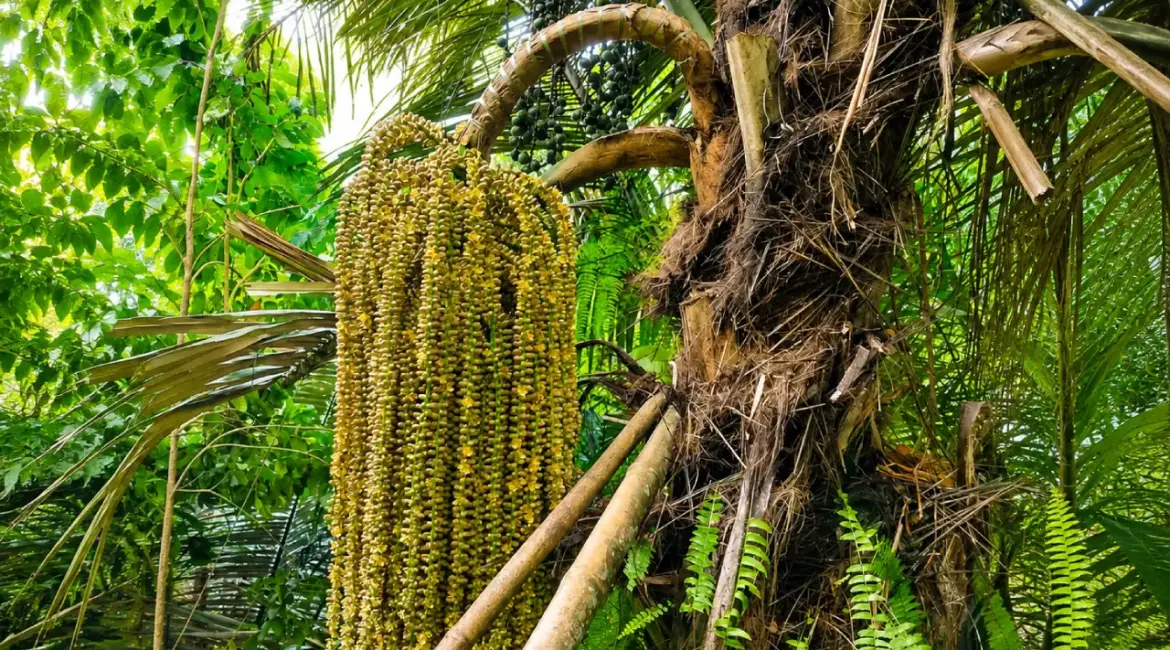
It comes from the arenga palm (Arenga pinnata), known locally in parts of Central Vietnam as ta vat. The tree grows in the mountainous areas of the Truong Son range, where it has been connected with the life of local communities for a very long time.
But getting nectar from an arenga palm is not as simple as cutting a flower stalk and waiting for the liquid to come out.
Before a single drop can be collected, the flower must be prepared for weeks. The process requires time, physical work and, most importantly, experience.
For Hoa Arika, understanding this process is also important because it explains why arenga nectar is very different from an ordinary industrial sweetener.
Harvesting arenga palm nectar is a long and highly skilled process.
Before nectar can be collected, the flower stalk is usually prepared for around 30–45 days. Experienced tappers then cut the stalk and collect the fresh nectar regularly, often every few hours, before fermentation begins.
Arenga Palm in the Mountains of Central Vietnam
Arenga palms grow naturally in many mountainous parts of Central Vietnam.
Hoa Arika works with local people in areas such as Dong Giang, Tay Giang and Nam Giang, in the Truong Son mountains west of Hoi An.
Many of the people who know how to harvest ta vat nectar are from the Co Tu community. Knowledge about the tree and how to work with its flowers has been passed between generations.
Unlike a commercial plantation where trees may be planted in straight rows and easily reached by vehicle, many arenga palms grow naturally in the mountains.
Some trees are close to villages. Others can be much deeper in the forest.
To reach some harvesting areas, tappers may have to walk 3 – 5 kilometres into the mountains, carrying their tools and collection containers with them.
And they do not make this journey only once.
Once a tree is producing nectar, they need to return again and again.
The Nectar Comes from the Flower, Not the Fruit
One thing that sometimes causes confusion is where palm nectar actually comes from.
Arenga nectar is not juice from the arenga fruit.
The nectar is collected from the flower stalk of the palm.
Before the flowers fully develop, an experienced tapper selects a suitable flower bunch and begins preparing it for tapping.
This preparation stage is one of the most important parts of the whole process.
If the flower is not prepared correctly, it may produce very little nectar – or none at all.
Preparing the Flower Can Take 30–45 Days
For arenga palm, the flower usually needs around 30 – 45 days of preparation before nectar can be collected.
During this period, the tapper repeatedly works on the flower stalk. The process is sometimes simply described as “massaging” the flower, although in practice it can involve a combination of handling, tapping, bending and carefully working the stalk.
The purpose is to prepare the flower so that nectar will flow after the end of the stalk is eventually cut.
A common practice is to work on the flower twice a day during this preparation period.
That means one flower bunch can require a lot of attention before harvesting even begins.
However, this is not a fixed formula for every tree.
Experienced Tappers May Work Differently
One detail we find especially interesting is that highly experienced tappers do not always need to work on the flower twice every day.
Some experienced people can prepare certain flowers only once every two days and still achieve a good result.
This does not mean that doing less work is automatically better.
The important point is that an experienced tapper knows which flower can be treated this way and which one cannot.
They look at the condition of the flower, the tree and how the stalk responds during the preparation process. From experience, they can decide whether the flower needs more frequent attention or whether it can be left for a longer interval.
This is difficult to learn from a written instruction.
Two flower bunches may look similar to an inexperienced person but behave very differently when tapped.
That is why arenga nectar harvesting depends so much on practical knowledge accumulated over many years.
Not Every Flower Will Give Nectar
Even after weeks of preparation, success is not guaranteed.
Not every flower bunch produces a good flow of nectar.
Sometimes the tapper can spend many days preparing a flower only to find that the nectar flow is weak.
This is another reason why experience is so important.
A skilled tapper becomes better at selecting suitable flowers, understanding the condition of the tree and adjusting the preparation process.
There is no machine measuring every decision.
Much of the work still depends on observation, touch and experience.
Cutting the Flower and Starting the Harvest
After the preparation period, when the tapper believes the flower is ready, the end of the flower stalk is cut.
If the preparation has been successful, fresh nectar begins to come from the cut surface.
A container is placed underneath to collect it.
The nectar at this stage is very different from concentrated palm syrup.
Fresh arenga nectar is a light, naturally sweet liquid containing a large amount of water. It has a delicate flavour and is highly perishable.
The harvesting work does not end after making the first cut.
The tapper needs to continue maintaining the cut surface and collecting the nectar regularly.
Fresh Nectar Has to Be Collected Quickly
One of the biggest challenges with fresh arenga nectar is that it can ferment very quickly.
In the warm climate of Central Vietnam, fresh nectar may begin changing within only a few hours.
For the arenga nectar we work with, collectors may return approximately every three hours to collect the fresh nectar.
After around four hours, fermentation can already start to become noticeable, especially if the nectar remains in warm conditions.
This creates a very practical problem.
Imagine a palm several kilometres inside the mountains.
The tapper has to walk to the tree, collect the nectar, take care of the flower stalk and then bring the nectar back out of the forest. A few hours later, the process starts again.
It is much more labour-intensive than simply harvesting a fruit once when it becomes ripe.
From the Forest to Hoi An
For Hoa Arika, collecting the nectar is only the first part of the work.
Fresh nectar needs to be handled quickly after harvesting to control fermentation and preserve the flavour we want.
This is particularly challenging with arenga because the trees are located far from Hoi An and sometimes far from convenient roads.
The journey can begin with a person walking through the forest, followed by a motorbike journey through mountain roads, and eventually transportation towards Hoi An.
Behind a glass of drink in the Ancient Town, there can therefore be a surprisingly long journey.
It starts with one flower high in the Truong Son mountains.
A Truly Wild Ingredient
Another reason we value ta vat is the environment where many of these palms grow.
The arenga palms we work with are not intensively farmed like many commercial crops. Many grow naturally in the mountain and forest environment.
They are not dependent on the normal system of chemical fertilisers and pesticides used in intensive agriculture.
For us, this is what we mean when we describe the ingredient as truly organic in its origin: it comes from palms growing naturally in the mountains rather than from an industrial agricultural system.
We also think it is important to make this distinction clearly.
“Organic” can be an official certification with specific standards. We are not using the term here to claim that every batch carries an organic certification.
We are describing how these wild palms actually grow: naturally in the mountains, without conventional intensive farming.
More Than Just a Sweetener
When people taste arenga nectar in a drink, it is easy to think of it simply as another type of sugar.
But when you see how it is harvested, the ingredient becomes more interesting.
A flower may require 30 – 45 days of preparation before the first nectar can be collected.
The tapper may have to visit it repeatedly.
Some harvesting sites require kilometres of walking through the mountains.
The fresh nectar then needs to be collected every few hours because fermentation begins quickly.
And behind all of this is knowledge that cannot easily be replaced by a standard instruction manual.
At Hoa Arika Hoi An, we use arenga palm blossom nectar in several of our drinks because of its natural sweetness and distinctive flavour.
But we also want people to know the story behind it.
For us, ta vat nectar is not only an alternative to refined sugar.
It is an ingredient that connects a drink in Hoi An with the forests of the Truong Son mountains, the arenga palm and the knowledge of the Co Tu people who have worked with this tree for generations.
That journey begins long before the nectar reaches the glass.
Frequently Asked Questions
What is arenga palm nectar?
Arenga palm nectar is the naturally sweet sap collected from the flower
stalk of the arenga palm (Arenga pinnata). In parts of Central
Vietnam, the palm is locally known as ta vat.
Does arenga nectar come from the fruit?
No. Arenga palm nectar is collected from the flower stalk, not from the
fruit. The flower has to be carefully prepared before the stalk is cut
and fresh nectar can begin to flow.
How long does an arenga flower need to be prepared before tapping?
The preparation process usually takes around 30–45 days. During this
time, the flower stalk is repeatedly handled, tapped and worked to
prepare it for nectar collection.
How often do tappers prepare the flower stalk?
A common practice is to work on the flower twice a day. However, highly
experienced tappers may treat certain flowers only once every two days
and still achieve good nectar flow. Knowing which flowers can be handled
this way requires many years of practical experience.
How often is fresh arenga nectar collected?
Fresh nectar may be collected approximately every three hours. Because
it can begin fermenting quickly in warm conditions, collectors need to
return regularly and handle the nectar soon after harvesting.
Why does arenga nectar ferment so quickly?
Fresh arenga nectar contains natural sugars and water, making it highly
perishable. In the warm climate of Central Vietnam, fermentation can
begin within only a few hours if the nectar is not handled or cooled
appropriately.
Is arenga palm nectar organic?
Many of the arenga palms we work with grow naturally in the mountains
rather than in intensive agricultural plantations. They are not grown
using the conventional system of chemical fertilisers and pesticides
associated with intensive farming. However, this description of their
natural growing conditions should not be confused with an official
organic certification.
Where does Hoa Arika source arenga palm nectar?
Hoa Arika works with local communities in the Truong Son mountains of
Central Vietnam, including areas such as Dong Giang, Tay Giang and Nam
Giang, where Co Tu people have long experience working with the ta vat
palm.
Taste a Story from the Truong Son Mountains
At Hoa Arika Hoi An, arenga palm blossom nectar travels
from the forests of the Truong Son mountains to our drinks in Hoi An.
Come and taste this naturally sweet ingredient, harvested through weeks
of careful preparation and the experience of local Co Tu tappers.
Three palms. Three nectars. One sweet story from Hoi An.
Hoa Arika Hoi An
2A Phan Chau Trinh, Hoi An
Open daily: 7:00 AM–9:00 PM