


Most visitors travel from Hoi An to My Son Sanctuary as a half-day tour.
A minivan picks them up in town, follows the fastest main road, spends a couple of hours at the temples, and returns to Hoi An.
There is nothing wrong with that.
But we think My Son deserves a full day.
Not because you need an entire day inside the sanctuary, but because the countryside between Hoi An and My Son is one of the most beautiful and overlooked parts of Central Vietnam.
Instead of simply following the default route suggested by Google Maps, our favourite journey leaves Hoi An through quiet villages and rural landscapes around Cam Kim, Go Noi and Duy Hoa, before reaching the ancient Cham temples of My Son.
From there, the journey continues into the mountains, crossing Deo Le before finishing the afternoon at Suoi Tien – the Secret Waterfall.
It turns a simple visit to My Son into a full-day road trip through three very different landscapes: the peaceful countryside around Hoi An, the sacred mountain valley of My Son, and the forested hills of rural Central Vietnam.
For travellers who enjoy archaeology, small villages, mountain roads and seeing everyday Vietnamese life beyond the main tourist attractions, this can be one of the best full-day trips from Hoi An.
My Son Sanctuary Day Trip from Hoi An – At a Glance
Distance from Hoi An: Around 40 km by the direct route. Our scenic countryside route is longer.
Recommended time at My Son: Around 2 hours.
Best for: History, countryside, photography, independent travel and slow travel.
Best scenic route: Hoi An → Cam Kim → Go Noi → Duy Hoa → My Son.
Our favourite full-day loop: Hoi An → My Son → Deo Le → Suoi Tien → Hoi An.
Recommended transport: Scooter or private car.
Optional stops: Tra Ly Lotus Fields, Quang Da historical base, Vinh Trinh Reservoir, Suoi Mo and Dai Binh Fruit Village.
Why Visit My Son Sanctuary?
Hoi An is famous for merchant houses, lanterns and riverside streets.
My Son is completely different.
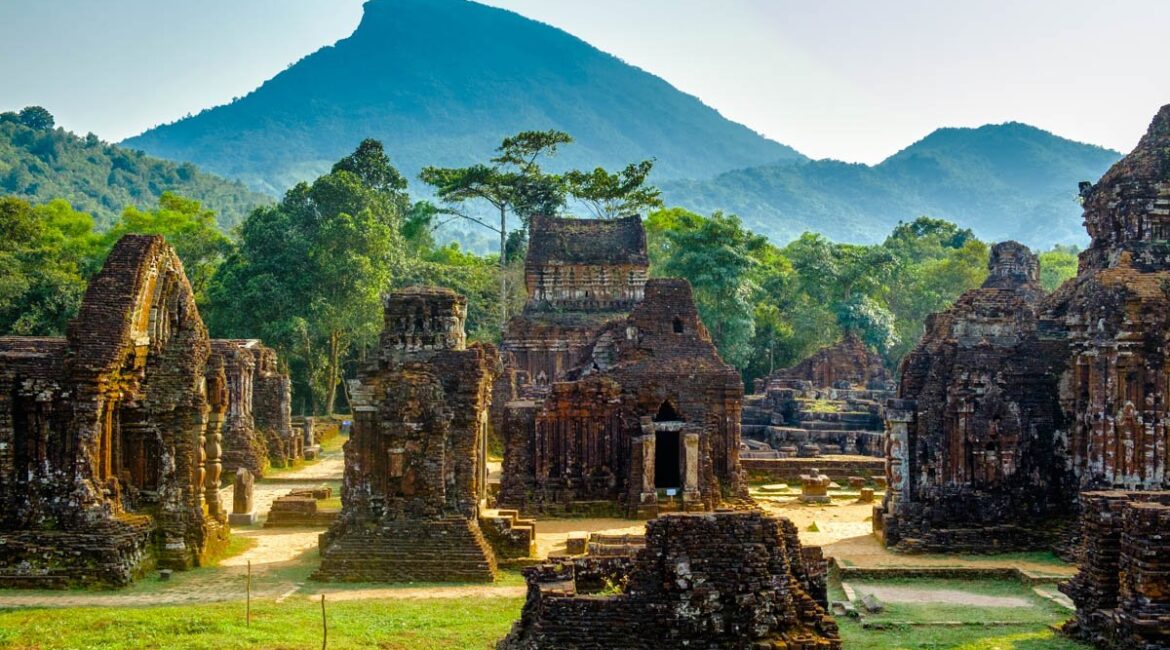
Hidden inside a green mountain basin, My Son Sanctuary was one of the most important religious centres of the ancient Champa Kingdom.
The sanctuary developed over many centuries, with its temples strongly influenced by Hinduism and particularly by the worship of Shiva. Today, the surviving red-brick towers, stone carvings and archaeological remains provide an extraordinary glimpse into the civilisation that once flourished across Central Vietnam.
My Son was recognised as a UNESCO World Heritage Site in 1999.
But its historical importance is only part of what makes the place special.
The setting is just as memorable.
The ancient brick towers stand inside a natural valley surrounded by forested mountains. Some structures remain remarkably detailed, while others survive only as walls, foundations and fragments scattered across the landscape.
It does not feel like a perfectly reconstructed historical park.
And that is part of its charm.
There is a sense that you are looking at something genuinely ancient, vulnerable and incomplete.
For many international travellers interested in history, archaeology and ancient cultures, that atmosphere can be far more compelling than a polished modern attraction.
How Far Is My Son Sanctuary from Hoi An?
My Son Sanctuary is roughly 40 km from Hoi An by the most direct road.
If your only goal is to arrive as quickly as possible, the standard navigation route is perfectly adequate.
But for a full-day journey, we recommend something different.
Instead of treating the road as transportation between Point A and Point B, we prefer to make the journey itself part of the experience.
The Best Scenic Route from Hoi An to My Son Sanctuary
Our preferred route follows smaller countryside roads through:
Hoi An → Cam Kim → Go Noi → Duy Hoa → My Son Sanctuary
It takes longer than the fastest route.
That is the point.
Instead of spending most of the journey on larger roads, you pass through farmland, riverside communities and villages that receive relatively few international visitors.
The landscape changes gradually as you travel west.
Hoi An’s busy streets disappear.
Houses become more scattered.
Rice fields, vegetable gardens, corn fields and small farms begin appearing beside the road.
Depending on the season, you may see farmers preparing their fields, transporting produce by motorbike, drying crops beside their homes or working around irrigation channels.
You will also pass small local markets, village coffee shops, family houses and everyday scenes that exist for the local community rather than for tourists.
Nothing here needs to be a famous attraction.
That is exactly what makes the journey interesting.
Cam Kim
Just across the Thu Bon River from Hoi An, Cam Kim provides an easy transition from the tourist centre into the countryside.
The roads quickly become quieter, passing traditional houses, gardens, farmland and small village communities.
It is an ideal beginning to the journey because you feel the atmosphere of Hoi An changing almost immediately after leaving town.
Go Noi
Continue inland towards Go Noi and the landscape becomes even more rural.
This agricultural area along the Thu Bon river system feels remarkably removed from busy central Hoi An despite not being especially far away.
There is no need to rush through it.
Slow down, ride carefully and enjoy the scenery.
Duy Hoa and the Countryside Near My Son
As you continue through the countryside around Duy Hoa, the landscape begins changing again.
Flat agricultural land gradually gives way to foothills, and the mountains surrounding My Son become visible in the distance.
By the time you arrive at the sanctuary, the road itself has already become an important part of your day.
What to See at My Son Sanctuary
Allow around two hours to explore My Son properly.
Do not treat it as a place where you simply walk between temples taking photographs.
If possible, first spend some time learning about the Champa Kingdom and the historical context of the sanctuary. Understanding who built My Son and why this isolated valley mattered makes the ruins much more meaningful.
As you explore the archaeological site, look closely at the brickwork.
Notice the sandstone carvings, architectural details and differences between the surviving temple groups.
Look at how the towers sit against the mountains and imagine what this religious complex might have looked like when it was active centuries ago.
Watch a Traditional Cham Cultural Performance
Another highlight of a visit to My Son is the opportunity to watch a traditional Cham cultural performance.
Performances usually include Cham dance, traditional costumes and music played with instruments associated with Cham culture. Depending on the programme, you may see graceful ceremonial dances, lively folk-inspired performances and the distinctive rhythms of traditional drums.
The performances add an important human dimension to the archaeological site. After seeing the ancient temples and religious sculptures, watching Cham music and dance helps visitors understand that Cham culture is not simply something that belongs to the distant past.
It is especially worthwhile for international visitors who may know very little about the Cham people before arriving in Central Vietnam.
The performances are held at scheduled times during the day, so it is worth checking the latest timetable when you arrive at the visitor centre. If possible, plan your walk around the sanctuary so you can include one performance without having to rush through the temple groups.
My Son is best appreciated slowly.
My Son Sanctuary Tickets, Opening Hours and Visitor Information
My Son Sanctuary is currently open from 6:00 AM to 5:00 PM.
Opening hours, entrance fees and performance schedules may change, so we recommend checking the latest information before your trip.
You can also check the My Son Sanctuary listing on Google Maps for current opening hours, visitor updates and directions:
View My Son Sanctuary on Google Maps
As of our latest update, international visitors should generally expect an entrance ticket of around 150,000 VND per adult.
The visitor experience normally includes transportation by electric shuttle from the entrance area towards the archaeological zone. Traditional Cham cultural performances are also held at scheduled times during the day.
Morning is usually the most comfortable time to explore the sanctuary, particularly during the hotter months in Central Vietnam. Arriving early also gives you more flexibility if you plan to continue towards Deo Le and Suoi Tien later in the day.
Where to Eat Near My Son Sanctuary
One advantage of turning My Son into a full-day journey is that lunch can become another part of the experience.
There are several restaurants near My Son Sanctuary that cater to travellers and are perfectly convenient for a comfortable lunch after visiting the temples.
If you prefer something more local, however, you will also find many small family-run restaurants along the countryside roads around My Son and on the way towards Deo Le. This is a great opportunity to try some of the everyday food that people in Quang Nam actually eat.
One local speciality worth looking for is ga tre Deo Le, a small local chicken associated with the area. It is often prepared simply so that the flavour and texture of the chicken remain the main focus of the dish.
Another excellent choice is Mi Quang, one of Central Vietnam’s most distinctive noodle dishes. Small Mi Quang restaurants are common along the route, and many are primarily frequented by local residents rather than tourists.
You may find several variations depending on the restaurant and what is available that day, including Mi Quang with pork, shrimp and egg, chicken Mi Quang, fish Mi Quang and even eel Mi Quang.
The noodles are usually served with a small amount of richly flavoured broth, fresh herbs, vegetables and crunchy toppings rather than as a large bowl of noodle soup.
Mi Quang is also relatively easy for most international travellers to enjoy. The flavours are savoury and aromatic without being especially challenging or unfamiliar, so if you have never tried it before, this countryside journey is a very good place to start.
For international visitors, eating Mi Quang at a simple roadside restaurant can be especially interesting because the dish is deeply connected with Quang Nam and Central Vietnam. The experience can feel very different from ordering the same dish in a restaurant in central Hoi An.
So whether you choose a traveller-friendly restaurant near My Son or stop at a small local Mi Quang shop along the road, we recommend making lunch part of the journey rather than simply treating it as a quick break.
A relaxed countryside lunch works particularly well before continuing towards Deo Le and Suoi Tien.
Whatever route you choose, bring plenty of drinking water, especially during Central Vietnam’s hotter months.
Interesting Places to Visit Near My Son Sanctuary
There are several worthwhile places around the wider My Son area.
However, we strongly recommend not trying to visit all of them in one day.
The goal is not to collect destinations.
Choose one or two depending on the season, weather, your interests and how much time you want to spend on the road.
1. Tra Ly Lotus Fields
If you travel during the summer, Tra Ly Lotus Fields can be one of the most beautiful optional stops on the way to My Son.
The best time to visit is generally from June through the end of August, when the lotus flowers are in season and the fields are at their most beautiful. Broad green lotus leaves, pink flowers and the mountains in the background create one of the loveliest rural landscapes in the area.
Early morning is usually the best time to visit, both for photography and for seeing the lotus flowers at their freshest.
However, Tra Ly is highly seasonal. After the lotus season ends, Central Vietnam enters its wetter months. The lotus fields may no longer have flowers, and some areas can become flooded during the rainy season.
The flooded fields can still create a beautiful and peaceful countryside landscape, especially with the surrounding mountains reflected in the water, but it is a very different experience from seeing the lotus in full bloom.
For this reason, we strongly recommend checking the current condition of the fields before making a special detour to Tra Ly. Ask a local, check recent photos or reviews online, or look for recent updates on Google Maps. This can save you time if the lotus season has already finished or access conditions are poor after heavy rain.
Unlike a purpose-built flower park, Tra Ly is a real agricultural landscape, so its appearance changes naturally with the season, weather and farming cycle.
That unpredictability is part of its charm – but it also means you should check before you go.
Best for: Photography and lotus flowers from June to August; peaceful rural and flooded-field scenery during parts of the rainy season.
2. Quang Da Special Zone Committee Historical Base
Hidden in the Hon Tau mountain area is a very different kind of historical destination: the former revolutionary base associated with the Quang Da Special Zone Committee.
This is much more niche than My Son and receives far fewer international visitors. Do not expect a major tourist attraction with extensive visitor facilities.
One of the nicest things about the site is its atmosphere. The historical area sits beneath the canopy of large old trees, making it quiet, shaded and surprisingly cool, even when the weather in the lowlands is much hotter. It is a peaceful place to slow down, rest and learn about another layer of local history away from the crowds.
Within the historical base, visitors can also see simple houses and working spaces associated with revolutionary leaders who lived and worked here around 55-70 years ago. These modest structures help make the history more tangible: rather than simply reading about events from the past, you can see the kind of secluded forest environment where local revolutionary leaders once stayed, held meetings and carried out their work.
The simplicity of the buildings, combined with the dense tree canopy and isolated mountain setting, gives visitors a much clearer sense of why this area was chosen as a base during that period.
However, getting there requires a little more planning. The road up is quite steep, especially in the final sections. If two people are travelling on one motorbike, we recommend using a sufficiently powerful bike – at least 125cc – and only attempting the ride if the rider is confident on steep rural roads.
If your bike is not suitable, or if you simply prefer not to ride up the steeper sections, another option is to walk approximately 5 km to reach the site. The walk takes more time and effort, but the shaded mountain environment makes it an interesting option for travellers who enjoy hiking.
Because road and weather conditions can change, especially during the rainy season, it is worth checking local conditions before making the detour.
The historical site is interesting precisely because it introduces visitors to a part of 20th-century Vietnamese history that most foreign travellers never encounter.
Best for: Travellers interested in Vietnamese history, quiet forested places and genuinely off-the-beaten-path destinations.
3. Vinh Trinh Reservoir
Vinh Trinh Reservoir is another quiet landscape in the wider countryside around My Son.
The reservoir is surrounded by rural scenery and hills and works best as a peaceful stop rather than a destination requiring several hours.
The area also carries an important and difficult historical memory connected with events during the 20th century.
For visitors interested primarily in scenery, the reservoir provides a tranquil break during the journey.
For those interested in modern Vietnamese history, the nearby historical memorial gives the area a deeper significance.
4. Suoi Mo
Suoi Mo lies farther towards the Dai Loc area and is better considered an alternative extension rather than an essential stop on the main My Son route.
The stream runs through a forested landscape and has long been a countryside escape for local people.
If forests, streams and nature interest you more than historical sites, you could build a separate My Son and Dai Loc itinerary around this area.
Best for: Nature lovers and travellers with extra time.
5. Dai Binh Fruit Village
Dai Binh Fruit Village is one of the most interesting rural villages farther west.
The village is known for its lush gardens and unusual variety of tropical fruit trees.
Walking or riding through Dai Binh feels very different from the dry, open countryside found in many other parts of Central Vietnam.
The greenery, orchards and traditional village atmosphere make it especially attractive for travellers interested in agriculture and local life.
Dai Binh can combine well with a journey across Deo Le, although adding it will make your day considerably longer.
For a relaxed itinerary, we would usually choose either Dai Binh or Suoi Tien rather than rushing through both.
A Perfect One-Day My Son Itinerary from Hoi An
This itinerary follows our favourite full-day loop:
Hoi An → My Son Sanctuary → Deo Le → Suoi Tien → Duy Vinh → Cam Kim → Hoi An
Places such as Tra Ly Lotus Fields, the Quang Da Special Zone Committee Historical Base, Vinh Trinh Reservoir, Suoi Mo and Dai Binh Fruit Village should be considered alternative side trips rather than stops on this loop.
After visiting My Son, you can either continue with our recommended route through Deo Le and Suoi Tien, or choose one of those alternative destinations depending on the season, weather and your interests.
6:30 AM – Leave Hoi An
Leave Hoi An early and begin the scenic countryside journey towards My Son.
Rather than simply following the fastest main road, take your time through the rural areas along the route. Morning is one of the nicest times to travel through the countryside, when the air is cooler and villages are beginning their day.
8:00–11:00 AM – Explore My Son Sanctuary
Allow around two to three hours to explore the archaeological site, learn about Champa history and, if the timing works, watch one of the traditional Cham cultural performances.
Try not to rush. My Son is much more rewarding when you have time to look closely at the temples, carvings and surrounding mountain landscape.
11:00 AM–12:30 PM – Lunch Near My Son
After leaving the sanctuary, stop for lunch either at one of the traveller-friendly restaurants near My Son or at a small local restaurant along the road.
This is a good opportunity to try Mi Quang or, if you continue towards Deo Le, look for the local ga tre Deo Le.
12:30–1:30 PM – Continue Towards Deo Le
After lunch, continue away from the main tourist route and into the hills towards Deo Le.
The scenery changes noticeably here. Flat farmland gives way to forested hills, winding roads and small rural communities.
1:30–2:15 PM – Cross Deo Le Mountain Pass
Take your time crossing Deo Le and enjoy the mountain scenery.
This is not a dramatic high-altitude pass like Hai Van Pass. Its appeal is quieter: green hills, rural roads and a feeling of travelling through a part of Central Vietnam that relatively few international visitors explore.
2:15–4:30 PM – Suoi Tien – The Secret Waterfall
Continue to Suoi Tien, where you can walk along the mountain stream, find a natural pool and relax beside the water.
You do not need to climb all the way to the highest waterfall. Explore only as far as the weather, terrain and your fitness comfortably allow.
After a morning of riding and walking around My Son, spending part of the afternoon beside a cool mountain stream is a perfect change of pace.
4:30 PM – Begin the Scenic Ride Back to Hoi An
Instead of simply taking the fastest road back into town, consider returning through Duy Vinh and Cam Kim.
Late afternoon is one of the most beautiful times to experience this countryside. The light becomes softer, farmers are finishing their work, people are returning home and village life slows down as the day comes to an end.
If you are not in a hurry, stop at a small countryside cafe or drink stall, order something cold and simply sit for a while overlooking the rice fields. Watching everyday rural life in the late-afternoon light can be just as memorable as visiting a famous attraction.
Optional Stop: Tra Nhieu Village
If you still have time and energy, make a detour through Tra Nhieu Village before returning to Hoi An.
Tra Nhieu offers a closer look at traditional village life around the Thu Bon River. Depending on what is operating when you visit, you may be able to experience a basket boat ride, see traditional mat weaving, explore small village roads or simply enjoy the peaceful riverside and agricultural scenery.
This is particularly pleasant in the late afternoon, when the temperature is cooler and the countryside takes on a much softer atmosphere.
5:30–6:30 PM – Cam Kim and Return to Hoi An
Continue through Cam Kim as the sun begins to set.
Depending on the season, you may pass rice fields glowing in the evening light, local people cycling home, farmers returning from the fields and families gathering outside their houses.
From Cam Kim, cross the river back towards central Hoi An and finish the journey around sunset or early evening.
Want a Different Afternoon After My Son?
You do not have to continue to Deo Le and Suoi Tien.
Depending on the season and your interests, you can instead choose one of the alternative destinations around My Son, such as Tra Ly Lotus Fields, the Quang Da Special Zone Committee Historical Base, Vinh Trinh Reservoir, Suoi Mo or Dai Binh Fruit Village.
We recommend choosing one direction rather than trying to fit everything into the same day. The best part of travelling through rural Central Vietnam is having enough time to slow down, stop when something catches your eye and enjoy the journey itself.
Scooter or Car: What Is the Best Way to Visit My Son?
For this particular full-day loop, a scooter or private car is the most practical choice.
A strong cyclist can certainly reach My Son, but adding Deo Le and Suoi Tien turns the journey into a significantly more demanding day.
A scooter offers the greatest freedom to stop whenever something catches your attention: a rice field, village market, mountain view, old house or roadside coffee stall.
But remember that countryside roads are still real working roads.
You may encounter farm vehicles, gravel, animals, children, roadworks and changing surfaces.
Mountain roads can also have blind bends and become slippery in wet weather.
Ride slowly through villages and only ride a motorbike if you are legally permitted, properly equipped and confident doing so.
Why We Prefer This Trip to a Standard My Son Tour
A normal My Son tour shows you My Son.
This journey shows you something bigger.
You see how quickly Hoi An changes once you leave the tourist centre.
You travel through villages beside the Thu Bon River.
You see farmers working and families going about their everyday lives.
You move from flat agricultural land into forested mountains.
You visit the ruins of a civilisation that flourished here more than a thousand years ago.
You eat somewhere most visitors to Hoi An will never hear about.
And before returning to town, you can spend the afternoon beside a mountain stream hidden in the hills.
My Son remains the centrepiece of the day.
But it is no longer the whole story.
Frequently Asked Questions
How far is My Son Sanctuary from Hoi An?
My Son Sanctuary is around 40 km from Hoi An by the most direct road. A scenic countryside route through Cam Kim, Go Noi and Duy Hoa will be longer but offers a much more interesting journey.
How long should I spend at My Son Sanctuary?
Allow around two to three hours to visit My Son comfortably. This gives you enough time to explore the main temple groups, learn about Champa history and enjoy the surrounding landscape without rushing.
Is My Son Sanctuary worth a full-day trip from Hoi An?
My Son itself does not necessarily require a full day, but combining it with the countryside between Hoi An and My Son, Deo Le and Suoi Tien creates an excellent full-day journey.
What is the best route from Hoi An to My Son Sanctuary?
If you want the fastest journey, follow the main road suggested by your navigation app. For scenery and local life, we prefer travelling through Cam Kim, Go Noi and Duy Hoa before reaching My Son.
Can I visit My Son Sanctuary and Suoi Tien in one day?
Yes. An early start makes it possible to explore My Son in the morning, cross Deo Le after lunch and spend part of the afternoon at Suoi Tien before returning to Hoi An.
Can I ride a scooter from Hoi An to My Son Sanctuary?
Yes, a scooter is one of the most flexible ways to explore this route, provided you are legally permitted to ride in Vietnam and are confident riding on rural and mountain roads.
Should I visit every attraction near My Son in one day?
No. We recommend choosing one or two additional stops rather than trying to visit Tra Ly, Vinh Trinh, Suoi Mo, Dai Binh and Suoi Tien all in the same day. A good road trip should still leave time to slow down and enjoy the journey.
Final Thoughts
My Son is often marketed as a convenient half-day excursion from Hoi An.
We think that undersells the journey.
Give yourself a full day.
Instead of automatically choosing the fastest road, travel through Cam Kim, Go Noi and the countryside towards Duy Hoa.
Walk slowly among the ancient Cham temples.
Then keep going.
Cross the mountains at Deo Le, find a simple local lunch and finish the afternoon beside the cool water of Suoi Tien.
Sometimes the best day trips are not about reaching one famous destination.
They are about everything you discover between the beginning and the end.
And for us, Hoi An → My Son → Deo Le → Suoi Tien is one of those journeys.
Taste the Three Palm Nectars in Hội An
After a day exploring My Son, mountain roads and the countryside of Central Vietnam, come discover another local story through the flavours of palm blossom nectar.
At Hoa Arika Hoi An, our drinks are sweetened with fresh blossom nectar from three Vietnamese palms: coconut, nipa and arenga – with no refined sugar.
Three palms. Three nectars. One sweet story from Hoi An.
Hoa Arika Hoi An
2A Phan Chau Trinh, Hoi An
Open daily: 7:00 AM–9:00 PM