
Nipa palm nectar is one of the three palm nectars we use at Hoa Arika Hoi An.
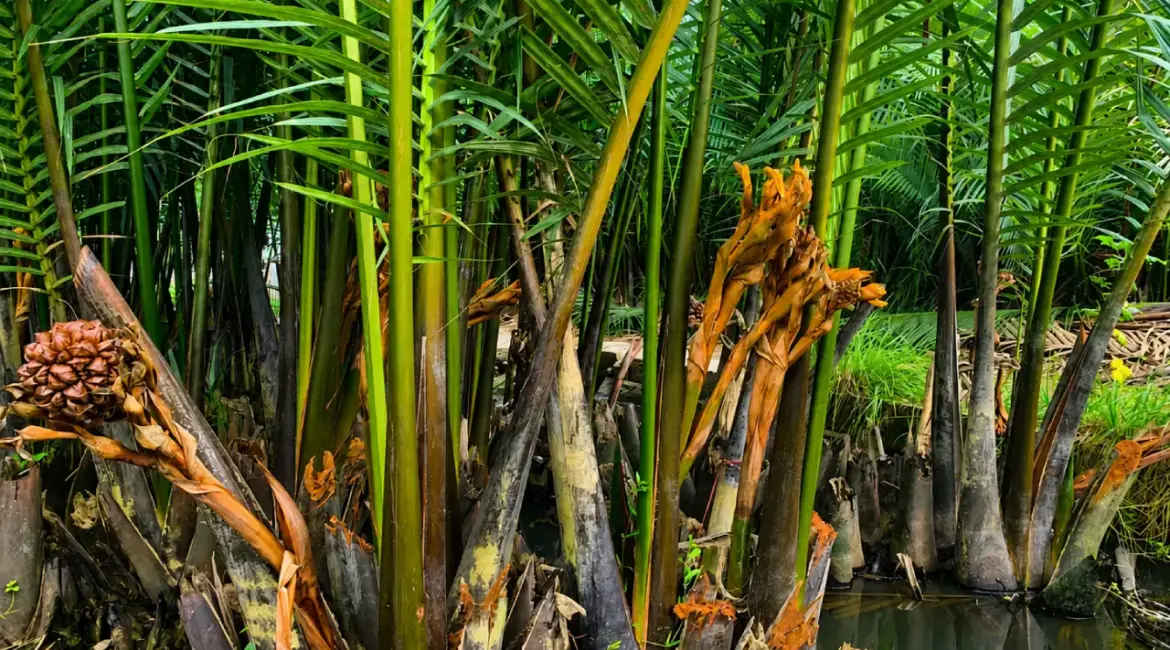
It comes from the nipa palm (Nypa fruticans), known in Vietnamese as dua nuoc. Unlike coconut palms growing high above the ground, nipa palms live along rivers, estuaries and brackish wetlands. Much of the plant grows close to or below the muddy ground, while its long leaves and flower stalks rise above the water.
Nipa palm is especially common in southern Vietnam and the Mekong Delta, where people have a long tradition of using different parts of the plant, including collecting its sweet sap.
Hoi An also has its own nipa palm landscape. But here, the story is a little different.
The palms have been part of the local waterways for generations, while the practice of collecting nectar from them has never been as common as in southern Vietnam. At Hoa Arika, we had to study, experiment and learn how to make nectar tapping work with the nipa palms growing around Hoi An.
Harvesting nipa palm nectar requires much more than simply cutting a stalk.
At Hoa Arika Hoi An, a suitable flower or fruit stalk normally needs around 10–15 days of preparation before nectar can be collected, although some may require around 20 days. Because only a limited number of nipa palms around Hoi An have suitable stalks for tapping, we also work with farmers in nearby areas and southern Vietnam to maintain a stable supply.
A Palm More Common in Southern Vietnam
Nipa palm is widely associated with the river and mangrove landscapes of southern Vietnam, particularly the Mekong Delta.
Hoi An’s nipa palms have an interesting local history.
There is no surviving written document showing exactly when the palms first appeared in Cam Thanh. However, local elders have said that nipa palms originally came from southern Vietnam and were brought back by local merchants travelling by traditional trading boats. The Hoi An Center for Cultural Heritage Management and Preservation records local accounts that the first nipa palms were planted in Cam Thanh more than 200 years ago.
So rather than saying there is an exact historical date, we prefer to think of this as a story going back roughly two to three centuries, when Hoi An still had strong trading connections by sea and river.
The palms adapted well to the brackish waterways around the lower Thu Bon River.
Today the best-known area is Cam Thanh, home to the famous nipa palm forest near Hoi An. Nipa ecosystems can also be found farther south along the Central Vietnamese coast, including areas of Nui Thanh in Quang Nam and Tinh Khe in Quang Ngai.
Traditionally, People in Hoi An Used the Palm in Other Ways
Although nipa palms became familiar in Hoi An, nectar tapping did not become an important local occupation.
Traditionally, local people found other practical uses for the plant.
The long nipa leaves were harvested and processed into materials for roofing houses, making walls, screens and large shade umbrellas. The old leaf bases could also be used as fuel. Local people also collected nipa fruits to eat or sell. Historical documentation from Cam Thanh describes leaf harvesting and production of nipa roofing materials as an important local livelihood.
This is still visible around Hoi An today.
The interesting thing is that a nipa palm has another valuable product that most visitors to Cam Thanh never see:
The sweet nectar inside its flower or fruit stalk.
The Nectar Does Not Come from the Fruit
Nipa palm nectar is not juice squeezed from a nipa fruit.
It is sap flowing through the stalk that supports the flower or fruit bunch.
A suitable stalk must first be selected and prepared. Only after this preparation period can the end of the stalk be cut and the nectar collected.
This pre-treatment is a recognised part of traditional nipa tapping. Research on nipa tapping has shown that the frequency and duration of preparation can significantly affect how much sap a stalk produces.
This is also what makes the process difficult.
You cannot simply walk into a nipa forest, choose any fruit bunch, cut its stalk and expect nectar to flow.
Learning How to Tap Nipa Palms in Hoi An
Because nectar tapping was not a common occupation around Hoi An, we could not simply find many local families already producing it.
At Hoa Arika Hoi An, we spent time researching and experimenting with the nipa palms available locally.
We learned that the condition of the stalk is extremely important.
Some flower stalks can be used.
Some fruit stalks can also be used.
But many are simply not suitable.
The tapper has to select a stalk with the right condition and development stage before beginning the preparation process.
This is one of the main limitations of producing nipa nectar in Hoi An.
There may be a large number of nipa palms in an area, but that does not mean there are a large number of stalks ready or suitable for nectar tapping.
Around 10 – 15 Days of Preparation
For the nipa palms we work with around Hoi An, preparation normally takes approximately 10 – 15 days.
During this period, the flower or fruit stalk is repeatedly worked and prepared.
The objective is to encourage the stalk to continue supplying sap after it is eventually cut.
This work has to be done carefully. Too little preparation may result in weak or no nectar flow. Incorrect handling can also damage the stalk.
And once again, there is no perfect number that applies to every plant.
Some stalks respond after around 10 days.
Others need closer to 15 days.
We have also worked with stalks that require around 20 days of preparation before they are ready.
This is why practical observation is important.
The calendar gives us a guideline, but the palm itself tells us when the stalk is ready.
Flower Stalk or Fruit Stalk?
Another interesting characteristic of nipa palm is that nectar can be obtained from different stages of the reproductive stalk.
Depending on the condition of the palm, we may work with a flower stalk or with a stalk carrying a fruit bunch.
The choice depends on what is available and whether the stalk is suitable for preparation.
For visitors, the large round nipa fruit bunch is normally the most familiar part of the plant. It is common to see these brown clusters hanging above the water in Cam Thanh.
But to a nectar tapper, the important part is the stalk behind the fruit or flower.
That is where the tapping work takes place.
Cutting the Stalk and Collecting the Nectar
When preparation is complete, the end of the stalk is cut.
If the stalk has responded well, nectar begins to flow from the fresh cut.
A clean container can then be attached below the stalk to collect it.
Fresh nipa sap naturally contains a significant amount of sugar. Research on fresh nipa sap has measured sugar levels around 16% in some locations, although composition varies according to geography, environment and tapping conditions.
Like other fresh palm nectars, it is also highly perishable.
Microbial activity begins changing the sap soon after collection, affecting its acidity, sugar composition, aroma and appearance. Research on nipa sap storage has observed measurable fermentation-related changes within only a few hours.
So good nectar harvesting is not only about making the sap flow.
It is also about collecting and handling it quickly.
Why Hoi An Cannot Produce Enough Nipa Nectar for Hoa Arika
Hoi An has a beautiful nipa palm landscape, especially around Cam Thanh.
But the amount of nectar we can realistically harvest here is limited.
The problem is not simply the number of palm trees.
Only a relatively small number of flower or fruit stalks meet the conditions we need for tapping. Some stalks cannot be prepared successfully, and nectar production also changes with the condition of the palm and the season.
For a small experiment, this is enough.
For a drink brand serving visitors every day, it is not.
That is why Hoa Arika does not depend entirely on the nipa palms of Hoi An.
From Hoi An to Nearby Provinces and the Mekong Delta
We try to harvest locally whenever suitable nipa palms are available.
At the same time, we cooperate with farmers in other parts of Central Vietnam where nipa palms also grow.
This includes areas around Nui Thanh and Quang Ngai, where significant nipa palm ecosystems still exist.
But southern Vietnam remains the most important source.
The Mekong Delta has much larger nipa palm resources and, more importantly, there are communities with greater experience in harvesting nipa nectar.
So when the supply from Hoi An and nearby areas is not enough, Hoa Arika works with farmers farther south.
For us, this is a practical way to keep the connection with Hoi An while also learning from the region where the nipa nectar tradition is much stronger.
A Sweetness with a Slightly Brackish Character
One reason we like nipa nectar is its flavour.
It is sweet, but it does not taste exactly like refined white sugar.
The nipa nectar we use can have a slightly salty or brackish note, something we naturally associate with the environment where the palm grows – river mouths, tidal waterways and wetlands close to the sea.
It is subtle.
You do not drink it and think that it tastes salty.
But behind the sweetness there can be a small mineral or brackish character that makes it different from other palm nectars.
For us, this is part of the identity of the ingredient.
Arenga nectar brings a story from the mountains.
Nipa nectar brings a story from the water.
What About Its Glycaemic Index?
Nipa nectar has also attracted attention because of its reported low glycaemic index.
In Vietnam, one commercially produced concentrated nipa nectar has reported a tested GI of 17, which is extremely low for a sweetener.
However, this number should be understood correctly.
It comes from testing of a specific concentrated nipa nectar product, not every nipa nectar produced in every location. GI can vary with sugar composition, concentration and processing.
So while around 17 is a useful reference for nipa nectar, Hoa Arika does not assume that every batch of our own nectar has exactly the same GI. Product-specific laboratory testing is the proper way to establish an exact value.
This distinction is important to us, especially when talking about nutrition.
How We Use Nipa Nectar at Hoa Arika
Nipa palm nectar has become one of the main sweeteners in our drink menu.
Its relatively clean sweetness and slight brackish character work especially well with coconut, coffee and matcha.
At Hoa Arika Hoi An, we use it in drinks such as Palm Blossom Colada, where nipa nectar combines with local pineapple, lime and coconut milk.
We also use it with cold brew coffee, nipa matcha, Vietnamese salted coffee and other drinks where we want sweetness without simply adding refined sugar.
Different drinks need different palm nectars.
Sometimes nipa works alone.
Sometimes we combine it with coconut or arenga blossom nectar to create a different flavour profile.
From a Familiar Palm to a New Ingredient in Hoi An
For generations, people around Hoi An have lived beside nipa palms.
They have used the leaves.
They have eaten the fruits.
They have built roofs, walls and shelters from the plant.
Nectar is a less familiar part of that story.
At Hoa Arika, we are trying to understand this part of the nipa palm better through research, practical tapping and cooperation with farmers who already have experience with the craft.
The process is still labour-intensive.
A suitable flower or fruit stalk has to be found.
It may need 10 – 15 days of preparation, sometimes around 20 days.
Not every stalk succeeds.
And even when nectar production is good, the fresh sap needs careful handling because it begins changing quickly after collection.
This is why a glass sweetened with nipa palm nectar represents much more work than simply replacing one spoon of sugar with another sweetener.
For us, it is also a way to look again at a plant that has been part of Hoi An’s waterways for more than two centuries – and discover something new inside a very familiar landscape.
Frequently Asked Questions
What is nipa palm nectar?
Nipa palm nectar is the naturally sweet sap collected from the flower
or fruit stalk of the nipa palm (Nypa fruticans). In Vietnam,
the plant is commonly known as dua nuoc and grows naturally along
rivers, estuaries and brackish wetlands.
Does nipa palm nectar come from the fruit?
No. The nectar is not juice extracted from the nipa fruit. It is sap
collected from the stalk that supports the flower or fruit bunch.
The stalk must first be prepared before it can be cut for nectar
collection.
How long does a nipa palm stalk need to be prepared before tapping?
For the nipa palms Hoa Arika works with around Hoi An, preparation
normally takes around 10–15 days. Some stalks respond more slowly and
may require around 20 days before they are ready for tapping.
Can both flower stalks and fruit stalks be used for nipa nectar?
Yes. Depending on the condition and development stage of the palm,
nectar can be collected from a suitable flower stalk or from the stalk
supporting a fruit bunch. Not every stalk is suitable, so selection is
an important part of the tapping process.
Why is nipa nectar production limited in Hoi An?
Although Hoi An has nipa palm areas, only a limited number of flower
and fruit stalks are suitable for successful nectar tapping. The
traditional nectar-tapping practice is also much less established here
than in southern Vietnam, so local production remains relatively small.
Where does Hoa Arika get its nipa palm nectar?
Hoa Arika harvests and experiments with nipa palms around Hoi An and
also works with farmers in nearby areas of Central Vietnam, including
Nui Thanh and Quang Ngai. When local supply is not enough, we cooperate
with farmers in southern Vietnam and the Mekong Delta, where nipa palms
and nectar tapping are much more common.
What does nipa palm nectar taste like?
Nipa palm nectar has a gentle natural sweetness with a subtle salty or
brackish character. For us, this slightly mineral taste reflects the
tidal rivers, estuaries and coastal wetlands where nipa palms naturally
grow.
Does nipa palm nectar have a low glycaemic index?
Nipa palm nectar is known for its low glycaemic index, and some tested
nipa nectar products have reported GI values around 17. However, the
exact GI can vary depending on the nectar, concentration and processing,
so a specific value should be confirmed by laboratory testing of the
actual product.
Which Hoa Arika drinks use nipa palm nectar?
Nipa palm nectar is used in several Hoa Arika drinks, including Palm
Blossom Colada, cold brew coffee, nipa matcha and Vietnamese salted
coffee. Its gentle sweetness and slightly brackish character work
especially well with coffee, matcha and coconut.
Taste a Sweet Story from Hoi An’s Waterways
At Hoa Arika Hoi An, nipa palm nectar connects our drinks
with the rivers and wetlands of Hoi An, as well as the long tradition of
nipa tapping in southern Vietnam.
Come and discover its gentle sweetness and distinctive slightly brackish
character in coffee, matcha, Palm Blossom Colada and other Hoa Arika drinks.
Three palms. Three nectars. One sweet story from Hoi An.
Hoa Arika Hoi An
2A Phan Chau Trinh, Hoi An
Open daily: 7:00 AM–9:00 PM