
Sweetness is an important part of many drinks, but not every sweetener tastes the same.
Refined white sugar gives a strong and direct sweetness. However, it has very little flavour or aroma of its own. When too much is used, it can easily cover the more delicate taste of tea, coffee, fruit or herbs.
Palm blossom nectar is different.
Besides making a drink sweet, it brings its own natural aroma and flavour. Its sweetness is usually softer, smoother and less sharp than refined sugar.
At Hoa Arika Hoi An, every drink is sweetened with fresh nectar from one or more of three palm species:
- Nipa palm
- Coconut palm
- Arenga palm
Each nectar has its own taste. They are also valued for their low glycaemic index, natural minerals, electrolyte minerals and small amounts of other plant-based nutrients.
Palm nectar is still a natural source of sugar and should be enjoyed in moderation. However, compared with highly refined white sugar, it offers more than sweetness alone.
A Softer Sweetness Than Refined Sugar
One of the first differences people notice about palm blossom nectar is its gentle sweetness.
Refined sugar can taste quite sharp, especially when used in a large amount. It mainly adds sweetness without adding much aroma or flavour.
Fresh palm nectar has a more rounded taste. Its sweetness usually develops more gently in the mouth and leaves a softer finish.
This is especially useful in drinks made with ingredients that have delicate flavours, such as:
- Cold-brew tea
- Matcha
- Vietnamese coffee
- Fresh fruit
- Nut milk
- Herbs and spices
Palm nectar sweetens these ingredients without covering their natural character.
It also contains organic acids, amino compounds, phenolic compounds and natural aroma substances that are not normally present in highly refined white sugar. The exact composition depends on the palm species, growing conditions, season and production method.
Three Palm Nectars, Three Different Flavours
The three palm nectars used by Hoa Arika Hoi An do not taste exactly the same.
Their flavours are influenced by the palm species, soil, water, weather, maturity of the flower stalk and time of harvest. Heating and concentration can also change the colour and aroma.
This gives each nectar a different role in our drinks.
Nipa Palm Nectar: Light and Refreshing
Nipa nectar comes from the flower stalk of Nypa fruticans, commonly known in Vietnam as the water coconut palm.
Fresh nipa nectar generally has a light, clean and refreshing sweetness. It does not have a heavy aftertaste, so it works well in drinks where freshness is important.
At Hoa Arika, nipa nectar pairs particularly well with:
- Cold-brew tea
- Fresh citrus fruit
- Coffee
- Milk-based drinks
- Light herbal flavours
When nipa nectar is gently concentrated, it may develop mild caramel notes while keeping a relatively clean finish.
Studies of nipa palm syrup have identified sucrose, glucose, fructose, organic acids, polyphenols, minerals and natural flavour compounds. Nipa sap and syrup have also been found to contain only negligible amounts of fat.
Coconut Blossom Nectar: Smooth and Floral
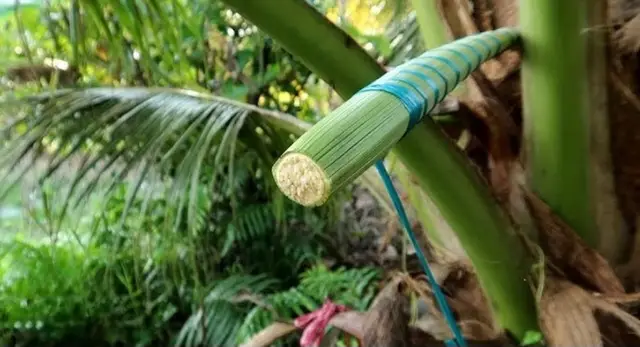
Coconut blossom nectar is collected from the flower stalk of Cocos nucifera.
It is not coconut water, coconut milk or coconut cream. It is collected before the flowers develop into mature coconuts.
Coconut blossom nectar usually has a smooth and familiar sweetness, with light floral and caramel-like notes.
It does not make every drink taste strongly of coconut. Instead, it blends naturally with other ingredients.
It works especially well with:
- Coffee
- Matcha
- Pineapple and tropical fruits
- Nut milk
- Tea
- Sparkling drinks
Coconut sap naturally contains sugars together with minerals, vitamins, phenolic compounds and other plant components. Its composition can change according to the coconut variety, growing conditions and the way it is collected and processed.
Arenga Palm Nectar: Deep and Complex
Arenga nectar comes from Arenga pinnata, a forest palm found in the Truong Son mountains.
Among our three nectars, arenga usually has the deepest and most noticeable flavour.
Depending on the tree, harvest and processing method, it may have:
- Floral notes
- Earthy notes
- Light nutty flavours
- A gentle caramel character
Arenga nectar works well with stronger ingredients such as Vietnamese coffee, citrus fruit, roasted flavours, spices and nut milk.
Because it has more flavour of its own, arenga nectar is not only used to make a drink sweet. It can become an important part of the drink’s overall taste.
Scientific analysis of sugars made from nipa, coconut and arenga palms has also shown that each palm species produces a different profile of volatile aroma compounds. This helps explain why their flavours can be clearly different even when their sweetness levels are similar.
Low Glycaemic Index
One of the main nutritional advantages of palm blossom nectar is its low glycaemic index, commonly called low GI.
The glycaemic index describes how quickly a carbohydrate-containing food affects blood glucose after it is consumed.
A high-GI sweetener is digested and absorbed more quickly, while a low-GI sweetener generally produces a slower and more gradual rise in blood glucose.
The three palm nectars used by Hoa Arika Hoi An – nipa, coconut and arenga – are valued as low-GI natural sweeteners.
This makes them a more balanced alternative for people who want to reduce their use of highly refined sweeteners while still enjoying naturally sweet drinks.
A human study of coconut inflorescence sap powder reported a GI of 52.47, which is within the commonly used low-GI category. Research on arenga palm sugar has also reported low in-vitro GI values, although exact results can vary according to the product and testing method.
The precise GI of palm nectar can be affected by:
- Palm species
- Growing conditions
- Sugar composition
- Degree of concentration
- Heating method
- Storage and fermentation
- Other ingredients in the final drink
For this reason, Hoa Arika Hoi An will publish specific GI numbers only after laboratory testing of the actual nectars used in our drinks.
It is also important to understand that low GI does not mean sugar-free or calorie-free. Palm blossom nectar still contains natural sugars and should be consumed in a reasonable amount.
Natural Minerals
Refined white sugar is mainly purified sucrose. During the refining process, most of the minerals and other natural plant compounds are removed.
Palm blossom nectar is less refined and retains more of the natural components found in the sap.
Studies of nipa, coconut and arenga palm products have identified minerals including:
- Potassium
- Sodium
- Magnesium
- Calcium
- Phosphorus
- Iron
- Zinc
- Manganese
Potassium is often one of the main minerals found in palm sap. Sodium, magnesium and calcium may also be present in different amounts.
Research on nipa sap and syrup identified potassium and sodium as the main minerals, together with phosphorus, magnesium, calcium, iron, copper, zinc and manganese.
Coconut sap has also been found to contain potassium, sodium, magnesium, calcium, zinc and iron. The actual quantities depend on the tree, soil, environment and harvesting method.
These minerals make palm nectar more nutritionally complex than refined white sugar.
However, palm nectar should not be considered a mineral supplement. The amount of each mineral in one drink may be modest and can vary between harvests.
Natural Electrolyte Minerals
Some of the minerals found in palm nectar are also electrolytes.
Electrolytes are minerals that carry an electrical charge when dissolved in body fluids. They are involved in important functions such as fluid balance, nerve signalling and normal muscle activity.
The electrolyte minerals naturally found in palm nectar may include:
- Potassium
- Sodium
- Magnesium
- Calcium
This is one reason fresh palm sap has traditionally been enjoyed as a refreshing drink in many tropical regions.
However, Hoa Arika does not describe its drinks as sports drinks or medical electrolyte-replacement products. Such claims would require laboratory testing of the finished drink and confirmation of the amount of each electrolyte.
The more accurate statement is that palm blossom nectar naturally contains electrolyte minerals.
Vitamins and Other Natural Plant Compounds
Fresh palm sap may also contain small amounts of vitamins, amino acids, phenolic compounds and antioxidants.
Research on coconut inflorescence sap has identified vitamin C and several other micronutrients. Nipa syrup studies have also found phenolic compounds and other naturally occurring plant components.
However, vitamin levels are not always stable.
They can change because of:
- Heating
- Long storage
- Exposure to air
- Fermentation
- Concentration methods
For this reason, it is more accurate to say that palm nectar naturally contains small amounts of vitamins and plant compounds, rather than claiming that every palm nectar product is rich in vitamins.
Freshness and careful handling are therefore important not only for flavour, but also for preserving the natural qualities of the nectar.
Naturally Low in Fat
Palm blossom nectar is naturally very low in fat.
Most of its energy comes from natural carbohydrates, mainly sugars, rather than fat. Analysis of nipa palm sap and syrup, for example, found only negligible fat content.
However, low in fat does not mean that palm nectar cannot contribute to weight gain.
Palm nectar still contains calories. When a person regularly consumes more energy than the body uses, the excess energy can contribute to weight gain, whether it comes from sugar, fat or other nutrients.
The advantage of palm nectar is not that it can be consumed without limits.
Its advantage is that it provides sweetness together with:
- Natural flavour
- Minerals
- Electrolyte minerals
- Small amounts of vitamins and plant compounds
- A lower glycaemic response than refined sugar
Like all sweeteners, palm blossom nectar should still be used in moderation. The World Health Organization includes sugars naturally present in syrups within its definition of free sugars and recommends limiting total free-sugar intake as part of a balanced diet.
Can Better Flavour Help Us Use Sweetness More Carefully?
Palm nectar has more flavour than refined white sugar.
This does not automatically mean that every drink contains less sugar. The amount still depends on the recipe and the desired level of sweetness.
However, because palm nectar contributes floral, fruity, earthy, nutty and caramel-like notes, it can make a drink feel more complete without relying only on intense sweetness.
At Hoa Arika Hoi An, we develop each recipe around the natural character of the nectar:
- Nipa nectar for a light, clean and refreshing sweetness
- Coconut blossom nectar for a smooth, floral and familiar sweetness
- Arenga nectar for a deeper and more complex flavour
Some drinks use only one nectar so guests can experience its individual character.
Other drinks combine two or all three to create a more balanced and layered sweetness.
Why Hoa Arika Chooses Palm Blossom Nectar
Hoa Arika Hoi An does not use palm blossom nectar only because it is different from refined sugar.
We choose it because it brings together several important qualities:
- A gentle sweetness that does not overpower other ingredients
- A natural flavour that changes with each palm species
- A low glycaemic index
- Naturally occurring minerals and electrolytes
- Small amounts of vitamins and plant compounds
- Very little fat
- A close connection with Vietnamese farmers and local landscapes
Every drink at Hoa Arika is sweetened with at least one of our three fresh palm nectars. Some recipes combine two or all three.
The nectar is collected by our farming team or by farmers who work directly with Hoa Arika. We remain closely involved in its tapping, collection, handling and processing because freshness has a strong influence on both flavour and quality.
A More Natural Way to Enjoy Sweetness
Palm blossom nectar is not medicine, and it is not sugar-free.
But it is a less refined and more flavourful way to sweeten a drink.
Compared with refined white sugar, it offers a gentler taste, its own natural aroma and a wider range of naturally occurring nutrients.
For Hoa Arika Hoi An, this makes palm nectar much more than a replacement for sugar.
It is the ingredient that gives our drinks their sweetness, character and connection to the land.
Three palms. Three nectars. One sweet story from Hoi An.
Taste the Three Palm Nectars in Hoi An
Curious about how nipa, coconut and arenga blossom nectars taste?
Visit Hoa Arika Hoi An and discover drinks naturally
sweetened with fresh palm blossom nectar from the waterways, countryside
and mountains of Central Vietnam.
Three palms. Three nectars. One sweet story from Hoi An.
Hoa Arika Hoi An
2A Phan Chu Trinh, Hoi An
Open daily: 7:00 AM – 9:00 PM